If you’re shopping for a used boat, your pre-purchase survey will likely contain a long list of technical observations. One phrase that often raises questions for buyers is “engine alignment.”
It sounds serious—and sometimes it can be—but in many cases it’s also a routine maintenance item. Understanding what it means will help you decide whether it’s a minor adjustment or something that deserves closer attention before closing the deal.
What Engine Alignment Actually Is
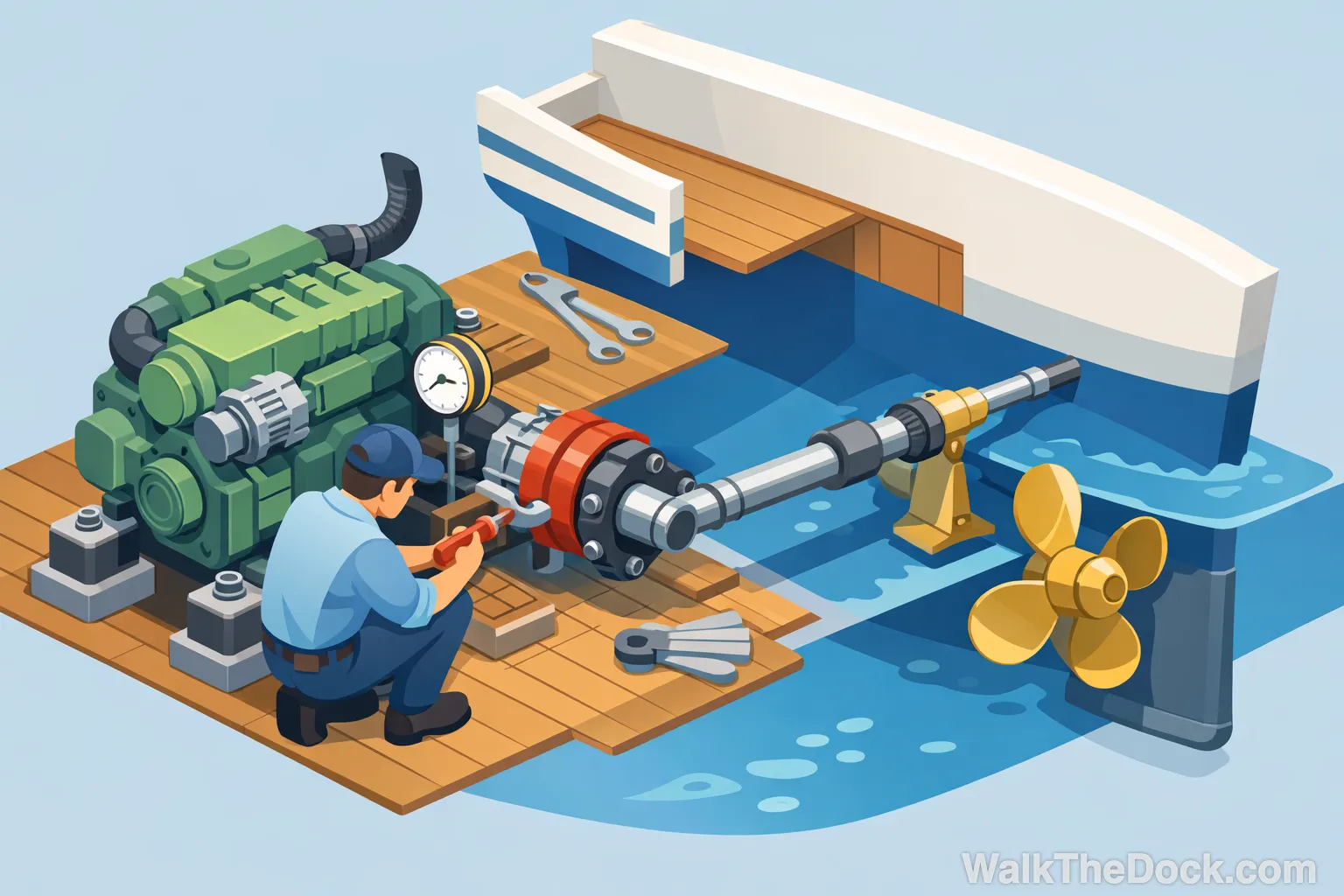
On most inboard boats, the engine is connected to the propeller through a propeller shaft. The engine turns a transmission, the transmission connects to a coupling, and that coupling joins the propeller shaft that runs through the hull to the propeller.
For this system to run smoothly, the engine and the shaft must be perfectly lined up. The mating faces of the transmission coupling and the shaft coupling need to be both centered and nearly perfectly parallel.
If they’re not aligned within very tight tolerances (often just a few thousandths of an inch), the shaft is forced to operate slightly off-center.
Think of it like a car’s drivetrain: if the components aren’t lined up, vibration and wear start to show up quickly.
Why Alignment Matters
Engine/shaft alignment is one of the most critical aspects of a boat’s propulsion system, yet it’s often misunderstood or neglected.
When alignment is off, several problems can develop over time:
-
Excess vibration underway
-
Premature wear of cutlass (shaft) bearings
-
Leaks or failure in the shaft seal or stuffing box
-
Increased fuel consumption due to drag
-
Damage to transmission bearings or the propeller shaft itself
In extreme cases, misalignment can even contribute to shaft damage or water intrusion.
Two Types of Alignment (Most Surveys Mean the First)
When surveyors mention alignment, they’re usually referring to engine-to-shaft alignment.
There are actually two related alignment relationships on most boats:
-
Engine-to-shaft alignment
The engine is adjusted on its mounts so the transmission output coupling lines up with the shaft coupling.
-
Shaft-to-bearing alignment
This refers to how the propeller shaft sits within its bearings and struts along its length.
Most marine mechanics are familiar with adjusting the engine alignment, which can usually be done with hand tools. Shaft-to-bearing alignment, on the other hand, is more specialized and less commonly addressed.
Why Alignment Can Change Over Time
Even if a boat was perfectly aligned when built, things shift as the vessel ages.
Common causes include:
-
Engine mounts settling or deteriorating
-
Structural changes in the engine beds or stringers
-
Worn shaft bearings
-
Propeller or shaft damage from grounding
-
Maintenance work that required separating the shaft coupling
This is why alignment checks are considered normal periodic maintenance, especially on older cruising boats.
A Key Detail Buyers Often Miss
One surprising point: a smooth-running boat doesn’t necessarily mean the alignment is correct.
Misalignment can exist without obvious vibration, which is why surveyors check it directly during inspections.
In other words, the absence of symptoms doesn’t guarantee everything is perfect.
How Difficult (or Expensive) Is It to Fix?
In many cases, correcting engine alignment is relatively straightforward.
Typically it involves:
-
Loosening the shaft coupling from the transmission
-
Measuring the gap between coupling faces
-
Adjusting the engine mounts up, down, or sideways
-
Rechecking until the couplings meet evenly
For an experienced mechanic, the analysis and adjustment often takes only a couple of hours.
Costs can range from a few hundred dollars for a simple adjustment to more if worn mounts, bearings, or other components need replacement.
What Buyers Should Do If It Appears in a Survey
If a survey mentions alignment, consider the context:
Usually minor:
Needs more investigation:
-
Severe vibration underway
-
Shaft difficult to rotate by hand
-
Evidence of worn bearings, mounts, or shaft damage
A good next step is asking the surveyor or a marine mechanic whether it appears to be a simple adjustment or a symptom of a larger driveline issue.
The Bottom Line
Seeing “engine alignment” in a boat survey is not automatically a deal breaker.
In many cases it simply reflects the reality that boats flex, settle, and age, and their drivetrains need occasional adjustment.
But it’s also an important signal: the propulsion system works with extremely tight tolerances, and even small misalignments can create expensive wear if ignored.
For buyers, the key is not to panic—but to understand the issue, ask the right questions, and factor the repair into your purchase decision.