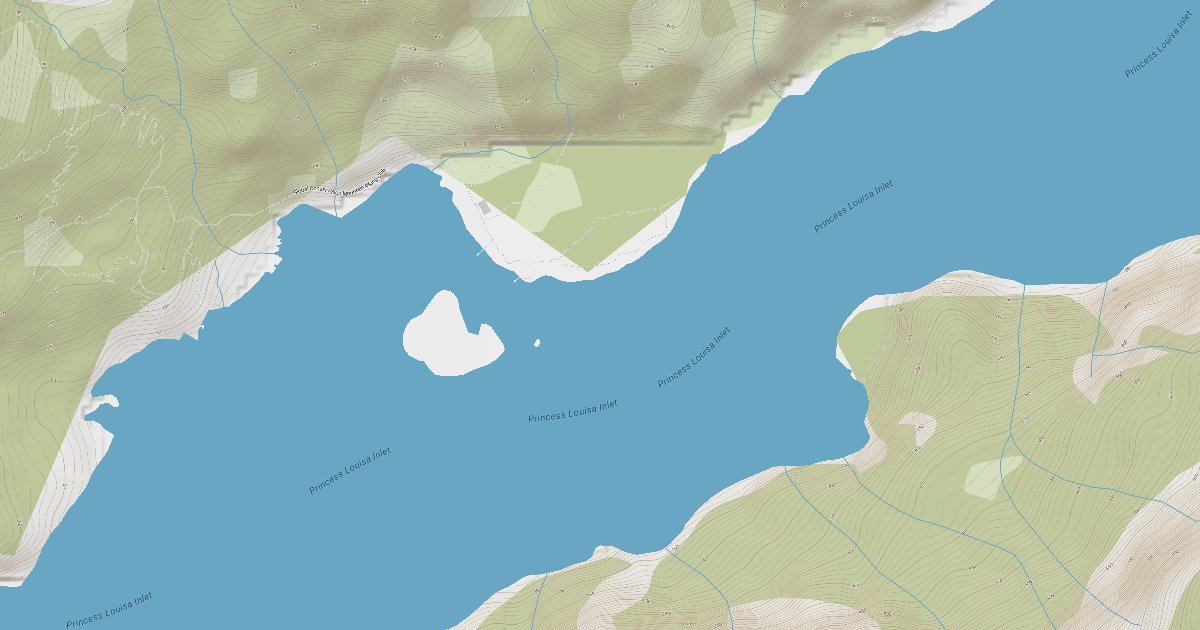
Princess Louisa Inlet

Often called the holy grail of Pacific Northwest cruising, Princess Louisa Inlet is a glacier-carved fjord whose 3,000-foot granite walls plunge to Chatterbox Falls at its head, reachable only through the tidal gate of Malibu Rapids.

40ftAvg Depth
MudHolding
4.8/5Wind Protection
/5Member Rating
PocketCapacity
About this Anchorage

Princess Louisa Inlet is a roughly 4-mile-long fjord branching off the head of Jervis Inlet, ringed by sheer 3,000-foot mountain walls that drop almost vertically into water 600 feet deep. The only way in is through Malibu Rapids, a narrow dogleg at the inlet's mouth that must be transited near slack water. Inside, the inlet is famously calm and protected, with cruisers describing the water as flat as a lake most of the time.

At the head sits Chatterbox Falls and the small Princess Louisa Marine Provincial Park, with a boat dock (max 55 ft / 17 m), a dinghy dock, mooring buoys, stern-tie rings set into the rock walls, a ranger cabin, picnic shelter, toilets, and short forest trails to the base of the falls. Because the inlet is so deep with very limited shallow shelf, most boats either take the dock, pick up a buoy, or anchor close to the rock wall with a stern line ashore.

True swinging anchorage is scarce, generally only one or two vessels directly in front of the falls, where the freshwater outflow current (about 2 knots) holds a boat steady. Otherwise the standard practice is bow-anchor-plus-stern-tie along the steep edges.

Be the first to follow Princess Louisa Inlet.
Local Knowledge

Approaches & Known Hazards

Approach notes, hazards to watch for, and what's available once you're tied up.

The sole entrance is Malibu Rapids, a narrow, S-shaped channel that runs at roughly 7-10 knots on the flood and ebb and should only be transited at or near slack. As a rule of thumb, slack at Malibu Rapids is about 25 minutes after high water and 35 minutes after low water at the Point Atkinson reference station; cruisers warn that consumer chartplotter/app current predictions are unreliable here and recommend Canadian Hydrographic Service tables. The channel is too narrow for two large vessels to pass safely, so it is standard to announce your identity and direction on VHF 16 before entering, and watch for whirlpools and eddies even near slack.

The 30-mile run up Jervis Inlet to reach the rapids offers essentially no safe anchorage en route, and the water is extremely deep throughout. Anchoring options inside Princess Louisa are limited to the head near Chatterbox Falls. Holding ground is largely rock, so a stern tie to the shore rings is strongly preferred over relying on the anchor alone.

What's nearby

  • Pet Friendly
  • Shore Access
Wind & Tides

Plan your stay

Wind protection summary and tide planning at a glance. Full per-direction and 7-day detail with Plus.

Wind Protection

Plus
4.8/5 Overall protection
Best from
N · NE · SE · S · SW
Weakest from
Unlock full wind rose

Tides

Plus
Rising High 19.1 ft at 8:31 PM
Current height
6.3 ft
Next extreme
High at 8:31 PM
7-day forecast
Unlock 7-day forecast
Right Now

Conditions

Live readings from the nearest OpenWeather station and WorldTides; refreshed every few minutes.

Live
Wind 3 kn SW
Air 57 °F Updated 1 second ago
Sky Overcast clouds OpenWeather
Tide Rising High 19.1 ft at 8:31 PM
Water Coming soon

Source: OpenWeather One Call API + WorldTides.

Tour

Walk through the anchorage

A curated photo + map walkthrough showing approach, mooring options, and points of interest.

Plus

A guided walkthrough of Princess Louisa Inlet with approach photos, depth notes, and points of interest — written by members who have been here recently.

Gallery

Photos from members

Member-uploaded images of this anchorage.

From the dock

Reviews & questions

Real first-hand reports and questions answered by members who have actually been here.

No reviews yet. Be the first.

Community

Keeping it current

Corrections from the WalkTheDock community

Cruising info goes stale fast — fees change, fuel docks close, hours shift. WalkTheDock stays accurate because boaters who’ve actually been here keep it current. Spot something out of date? Suggest a correction; once a moderator approves it the change goes live and you’re credited below.

No community updates yet — spotted something out of date? Use “Suggest an edit” below.